

9 Organic Cruelty-Free Beauty Products Worth Trying in 2026

Quick Summary
Organic cruelty-free beauty products are items made with plant ingredients grown and handled organically, and whose makers do not test on animals. Organic describes how ingredients are grown, while cruelty-free describes animal testing, so a product can carry one claim without the other. Check both labels and the ingredient list before buying.
- Organic describes how plant ingredients are grown and handled, not whether a product is gentle.
- Cruelty-free describes whether the company or its suppliers test on animals.
- Animal-derived ingredients such as lanolin or carmine are not cruelty-free, even if the brand avoids testing.
- Check the brand's own animal testing policy and whether it sells in markets requiring animal testing.
- Patch test new products on the inner forearm for three to five days before using them on your face.
Table of Contents
- What Organic and Cruelty-Free Actually Mean on a Label
- How to Identify Cruelty-Free Beauty Products
- Cruelty-Free Beauty Certification: What to Verify
- Organic Skincare for Sensitive Skin: What to Look For
- 1. Organic Sacred Frankincense Hyaluronic Acid Serum for Dry, Mature Skin
- 2. Organic Rosewater for Toning and Calming Redness
- 3. Organic Lavender Complexion Bar for Normal to Dry Skin
- 4. Organic Cocoa Body Butter and Organic Jojoba Oil for Body and Carrier Care
- Choosing by Budget and Skin Concern
- Booking Your Next Step: Start With a Trial Set or a Single Staple
- Frequently Asked Questions
Last Updated: October 28, 2026
Organic cruelty-free beauty products are easier to shop for once you know what each label actually promises. Natural Beauty Skincare® has made its skincare and body care in Gibsons, BC for over 30 years, and the range below is one place to start. The products in this guide are sorted by skin concern and budget so you can pick a starting point.
Organic describes how ingredients are grown and processed (Organic products). Cruelty-free describes whether animals were used in testing. Neither word tells you the product is gentle for your skin, so when you shop for organic cruelty-free beauty, the rest of this guide shows how to read a label with both in mind.
What Organic and Cruelty-Free Actually Mean on a Label
Organic refers to how the plant ingredients were grown and handled. Cruelty-free refers to whether the company or its suppliers test on animals. A product can carry one claim without the other, so check both before assuming a product meets your standard.
Many shoppers assume "natural" means the same thing. It does not. A label that says natural has no fixed meaning in most markets.
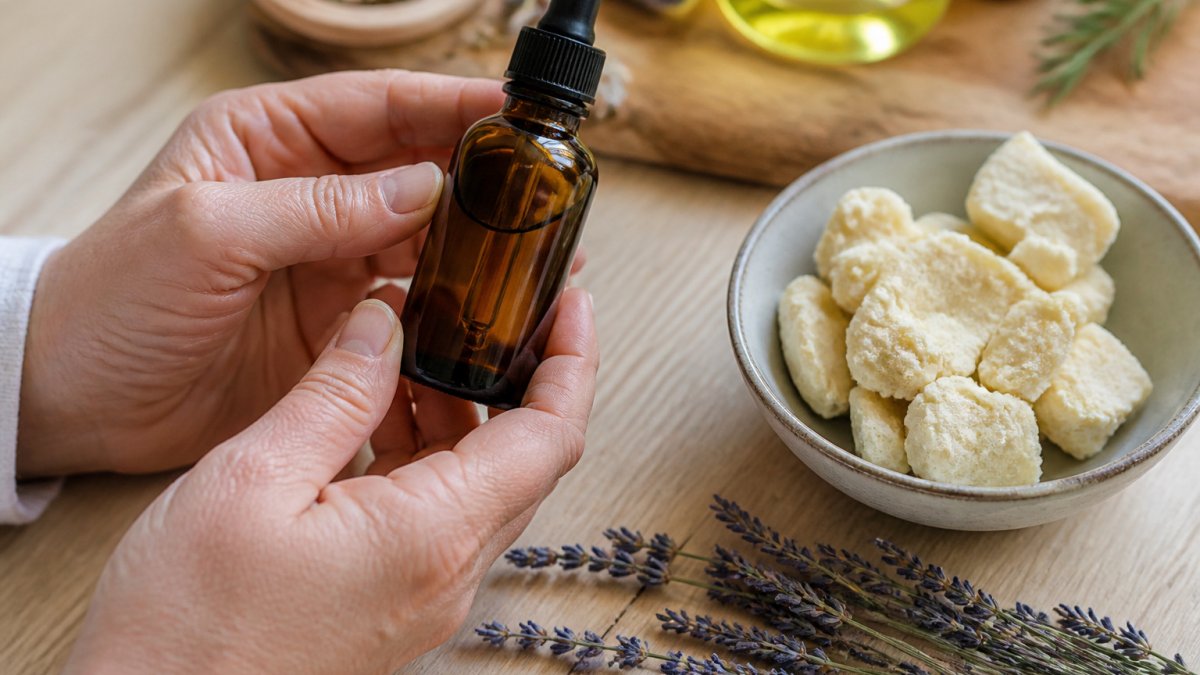
!Close-up of hands holding a small amber glass skincare bottle beside a bowl of cocoa butter and a sprig of lavender on a light wooden table
How to Identify Cruelty-Free Beauty Products
Start with the product's own website. Look for a clear animal testing policy and whether the company sells in markets that require animal testing. Our products are cruelty-free.
Read the ingredient list too. Animal-derived ingredients such as lanolin or carmine are not cruelty-free even when the brand avoids testing, so check the INCI list for them.
Cruelty-Free Beauty Certification: What to Verify
A certification logo is only as useful as the standard behind it. Two products can both carry a cruelty-free mark and still be held to very different rules, so the practical skill is knowing what each program actually audits and how to confirm a claim independently.
What a cruelty-free certification typically covers
Most programs verify three things: that the finished product was not tested on animals, that the brand does not commission animal testing, and that ingredient suppliers have provided assurances that no animal testing was performed on the ingredients. Some programs also require a fixed cut-off date, a date after which the brand commits that no ingredient it uses will ever be tested on animals. That cut-off date matters because it prevents a brand from relying on older ingredient safety data that was itself derived from animal testing.
When you check a certificate, look for:
- The standard's name and version, programs update their criteria, and an older certificate may not reflect current requirements.
- The scope, does the certificate cover the whole brand, a single product line, or only the manufacturing facility? A facility-level certificate does not guarantee the formula is free of animal-derived ingredients.
- The cut-off date, if the program uses one.
- The expiry or review date, so you know the claim is current.
How to verify a claim yourself
Start with the certifying body's own public directory rather than the logo on the package. Most programs publish a searchable list of certified brands and, in some cases, certified products. Cross-check the brand name exactly as it appears on the certificate, house brands and sub-brands are sometimes certified separately from the parent company.
Next, read the brand's animal-testing policy on its own website. A credible policy usually states:
- Whether the brand or any of its suppliers tests on animals.
- Whether it sells in markets that require animal testing by law, and if so, how it handles that requirement.
- Whether it uses animal-derived ingredients, and if so, which ones.
- The date the policy was last reviewed.
A policy that only says "we love animals" without addressing supplier testing or market requirements is marketing, not a verification.
Where organic certification fits in
Cruelty-free certification says nothing about how ingredients were grown. Organic certification is a separate audit, and it is worth checking whether it applies to the whole product or only to selected ingredients. A product described as containing organic ingredients may have only one or two certified-organic botanicals in the formula, with the rest conventionally grown. Look for the certifying body's name and a certificate number, then confirm the scope in that body's public registry.
A quick verification checklist
- Certification body named on the package or product page
- Brand listed in that body's public directory
- Certificate scope covers the product, not just the facility
- Animal-testing policy addresses suppliers and required-testing markets
- Organic claim specifies whole-product or ingredient-level certification
- Date of last verification recorded
Working through this list takes a few minutes per brand and is the difference between trusting a logo and knowing what it means.
Organic Skincare for Sensitive Skin: What to Look For
Sensitive skin is not one condition. If you are looking for a hydrating serum for dry, sensitive skin, this guide to choosing one covers what to look for in the formula. It is a set of reactions, stinging, redness, itching, tightness, or breakouts, that can come from fragrance, preservatives, surfactants, or simply a compromised skin barrier. The useful question is not "is this product organic?" but "which ingredients in this formula are most likely to trigger my reaction, and does the label tell me enough to judge?"
Screen the formula by category, not by slogan
A short ingredient list helps, but length alone is a poor filter. What matters is which categories appear and at what position.
What organic certification does and does not tell you
Organic certification confirms how specified ingredients were grown and processed. It does not confirm that a product is non-irritating. Treat organic status as one input, not a guarantee.
Gabriel Mascara | Vegan Natural Volumizing Mascara →
Check whether the certification applies to the whole formula or only to selected botanicals. A product may carry an organic claim because one or two ingredients meet the standard while the rest are conventional. The certifying body's name and a certificate number let you confirm the scope in that body's registry.
Read the INCI list in order
Ingredients are listed by concentration until the 1% mark, after which order is at the manufacturer's discretion. That means the first five to seven ingredients tell you most of what the product is. If a fragrance or a known trigger appears early, the product is probably not the right starting point for reactive skin. If it appears after the preservative, the amount is likely small.
Patch test with a method
Apply a small amount to the inner forearm twice daily for three to five days. If no reaction appears, repeat on a small area of the jawline for another three to five days before using it on the full face. Introduce one new product at a time so you can attribute a reaction correctly. Stop and discontinue if stinging, swelling, or spreading redness develops.
Match the product to the reaction
A product being organic and cruelty-free tells you about sourcing and testing. It does not tell you whether your skin will tolerate it, that judgment comes from the ingredient list and a careful patch test.
1. Organic Sacred Frankincense Hyaluronic Acid Serum for Dry, Mature Skin
This serum pairs organic sacred frankincense with hyaluronic acid. It is 99% natural and vegan, and it absorbs without a greasy residue. Apply a few drops to clean skin after cleansing and before moisturizer, then massage gently into the face and neck. The listing is priced at $49.99 CAD, and it can be used morning or evening.
You can view the Organic Sacred Frankincense Hyaluronic Acid Serum to read the full ingredient list before you buy.

2. Organic Rosewater for Toning and Calming Redness
This facial mist uses pure Rose Otto and colloidal silver as its preservation system, with no parabens or phenoxyethanol. It works well as a toner after cleansing. At $24.99 CAD, it is one of the more affordable ways to add a botanical toning step to your routine.
If redness is your main concern, see the Organic Rosewater formula and directions before you decide whether it fits your routine.

3. Organic Lavender Complexion Bar for Normal to Dry Skin
This bar is milled with a traditional French process and includes shea butter, calendula, olive oil, and organic lavender. It suits normal to dry skin and is gentle enough for family use. At $13.99 CAD, it is a practical starting point for cleansing.
You can browse the Organic Lavender Complexion Bar for the full ingredient breakdown and use directions.
4. Organic Cocoa Body Butter and Organic Jojoba Oil for Body and Carrier Care
Our Organic Cocoa Body Butter is made from cocoa butter and jojoba oil with no water or emulsifiers, and it comes in Lemon, Grapefruit, and Unscented versions. It costs $24.99 CAD for 100ml. Our Organic Jojoba Oil is a cold-pressed carrier oil at $39.99 CAD that works as a moisturizer, makeup remover, or base for diluted essential oils.
If you want a body moisturizer, see the Organic Cocoa Body Butter. For a carrier oil, explore the Organic Jojoba Oil.

Choosing by Budget and Skin Concern
Start with one product rather than buying a full routine at once. The serum, rosewater mist, and unscented body butter are options to consider.
The Organic Rose Travel Set, priced at $69.99 CAD, includes travel-size products from the organic rose collection.
Booking Your Next Step: Start With a Trial Set or a Single Staple
Visit the Natural Beauty Skincare® website to see current listings and choose a product.
Frequently Asked Questions
How can you tell whether a beauty brand is cruelty-free?
Look for a clear, current animal-testing policy on the brand's own website, and check whether it applies to finished products as well as ingredients. Some brands state that they do not test on animals and do not allow third parties to test on their behalf, while others only state that they do not test finished products. Third-party certifications and recognized logos can help, but check that the certifying body's criteria match your own standard. If a policy is vague or missing, ask the company directly before you buy. A written, specific answer is a better sign than a general claim on the packaging.
What does organic mean in skincare?
In skincare, organic generally means that the ingredients were grown and processed according to organic farming standards. A product can contain organic ingredients without being entirely organic, so the percentage matters. Natural and organic are not the same thing, so read the ingredient list rather than relying on the front of the package.
Are organic beauty products effective for sensitive skin?
They can be, but effectiveness depends on the formula, not the organic label alone. The Organic Eye Make-up Remover is a plant-based oil blend, and its listing describes it as suitable for sensitive skin.
What is the difference between cruelty-free and vegan beauty products?
Cruelty-free refers to whether animal testing was used in developing or producing a product. Vegan refers to whether the product contains any animal-derived ingredients. A product can be cruelty-free but not vegan. The Organic Sacred Frankincense Hyaluronic Acid Serum is described as vegan and cruelty-free, so check the labelling for both claims if they matter to you.
Natural Beauty Skincare® has made organic botanical skincare in Gibsons, BC for more than 30 years. Our products are cruelty-free, handcrafted, and designed for sensitive and dry skin. Start with one product and see how your skin responds.


Leave a comment